
Over the past two decades, China’s booming population and economy created a huge appetite for ag commodities. Urban growth, rising incomes and a shift to protein-rich diets turned the country into the largest buyer of soybeans and a major importer of grains.
Today, China’s consumption of soybeans and grains remains massive, but the era of steep year-over-year growth in imports shows signs of winding down – primarily due to demographic shifts, cultural changes and the nation’s push for self-sufficiency.
“I recently visited customers in China and heard something that I have never heard before: they expect demand to be flat,” says Jason Marthaler, vice president, CHS oilseed product line. “We are facing an inflection point. I’ve met with large crushers and feed millers in China for nearly 15 years, and this is the first time that everybody we met with said they expect demand to flatten.”
Years of massive growth
The impending plateau in demand follows a 20-year boom period during which China’s soybean imports surged by more than 250%. China imported around 28.2 million metric tons (MMT) of soybeans at the start of the 2005-2006 marketing year and is projected to import 106 MMT in the 2025-2026 marketing year, according to U.S. Department of Agriculture (USDA) data.
Prior to the late 1990s, China mostly bought finished products like soybean meal and oil rather than raw soybeans. As its population rose and diets improved, the country built crushing plants and a new market emerged for U.S. soybeans.
Brian Schouvieller, senior vice president, CHS ag product lines, was one of the first U.S. grain traders to visit China and establish trade on behalf of farmers and cooperative owners.
“Being part of the first team that connected our owners with the Chinese market was both challenging and exciting,” says Schouvieller, who recalls navigating language barriers, credit risks and first-time international buyers to establish early sales.
“We knew we were on the front end of something that was going to grow for a significant time, just due to the sheer size of the population and because we were starting at zero. But no one anticipated the trajectory would be 3% to 10% growth in volume consumed each year,” says Schouvieller.
“From the beginning, the Chinese buyers saw us as an extension of the farm because we are farmer-owned. Our customers feel they’re connected right to that acre, which they appreciate,” he adds. “We’ve always been driven to bring value to our owners and give them market access directly to the consumer.”
CHS now ranks as one of the top three grain suppliers to China, annually marketing approximately 285,000 bushels of soybeans directly to state-owned and privately held companies.
“We’ve built really strong relationships there, supported by our resilient supply chains and a dedicated team in China,” Schouvieller says.
To serve the fast-growing Chinese market over the years, CHS made many investments, such as opening a grain marketing office in Hong Kong in 2007; increasing the scope of its TEMCO joint venture terminal to include an export terminal at Kalama, Wash., in 2012 (later significantly expanded); and establishing a joint venture with Xinfeng Cereals and Oils Logistics Company in Nantong, China, to leverage local expertise and infrastructure for timely delivery of grains and oils to processors, wholesalers and retailers.
Powerful shifts underway
Previously the fastest growing nation in the world, China is projected to drop from 1.4 billion to 1.2 billion in population by 2060, according to U.S. Census Bureau data. In addition, the population is aging. By 2030, 18% of the population is projected to be over 65 years old compared to 15% under 15 years old. The country’s annual gross domestic product (GDP) growth is declining as well, from over 14% in the early 2000s to less than 5% now, according to the International Monetary Fund.
Recent studies suggest shifting preferences among younger consumers in China, including changes in spending priorities. “Consumption and population patterns are on the decline, and their dietary needs will likely decline as well,” says Gary Halvorson, executive vice president, CHS enterprise customer development.
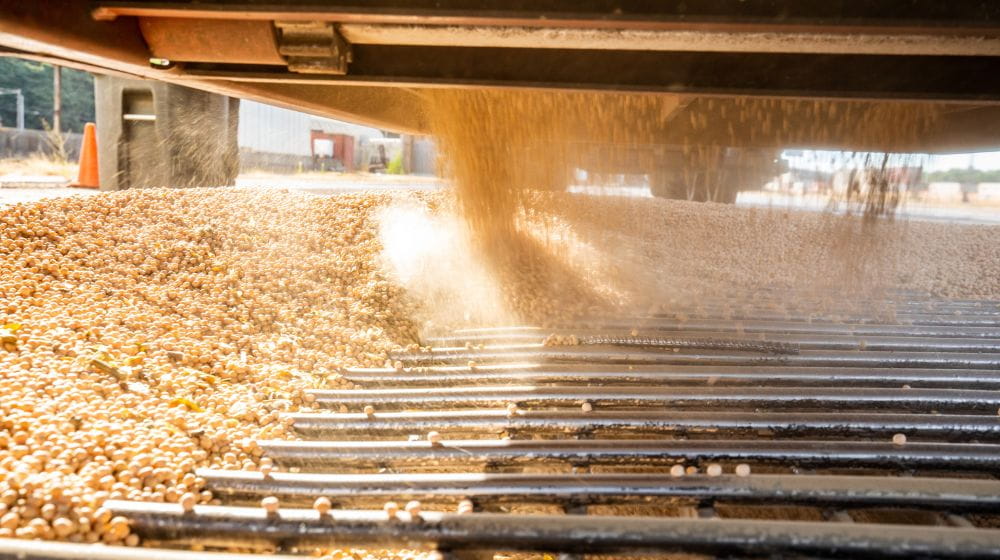
China remains a major market for U.S. soybeans, although demand is slowing down.
Greater competition for plateauing demand
The U.S. supplied 50% or more of the country’s soybean needs more than 20 years ago, but that number has dropped to about 20% as Brazil has become the dominant supplier, data shows. The U.S. is also facing stiff export competition for other commodities in China as world grain production increases and the country has worked to diversify its supply chains.
China is becoming more proficient in raising grain, particularly as its leaders elevate self-sufficient food security as a national priority. Efforts to boost production could slightly reduce imports over the next decade, though forecasts suggest China will continue importing large volumes of grains and oilseeds, according to the Sino-German Agricultural Centre.
Preferred supplier for the long run
CHS remains a leading ag supplier to China, having invested heavily in grain origination and export facilities to ensure market access for American farmers and cooperatives. It provides the country with soybeans, corn, wheat, canola, feed barley, sorghum, distillers dried grains with solubles (DDGS) and other commodities year-round through an extensive supply chain in North America, South America, the Black Sea and Australia.
“Unlike other competitors, CHS does not own crushing facilities in China. We operate as a pure trading partner with no competing interests of our own in China,” says Sunny Xu, CHS commodity marketing manager in Shanghai. “We listen to our customers’ needs. Our top priority is to deliver good customer service, which includes providing consistent quality and seamless execution.”
Handling origination from diverse regions and controlling logistics help CHS provide a reliable supply and stable grain quality year-round, which matters greatly to Chinese buyers, according to Xu.
This is particularly important as more grain flows to China from Brazil. “CHS is building the strength of our grain origination in Brazil with the Port of Santos terminal project, which will further enhance our competitiveness as a supplier to China,” she says.
“Last, but not least, our deep relationships with customers in China help make us a preferred partner,” explains Xu. “Chinese customers are highly engaged with global markets and seek to understand supply-side dynamics. As a large farmer-owned company, we can share insights into U.S. farmer sentiment – offering timely, valuable market intelligence that complements USDA reports and other data on planting intentions, yield estimates and global price reactions.”

CHS has built strong relationships with customers in China, who value working with a farmer-owned cooperative.
Cooperative system’s ability to respond quickly – or pivot
Years of customer service have earned CHS a spot on the short list for Chinese buyers, including those that prefer storage-friendly soybeans from the Pacific Northwest (PNW) region, where CHS is a top exporter through its TEMCO joint venture.
“Our product-line operating model connects our customers in China all the way back to our affiliate network and farmers, like my family’s farm in central Minnesota,” says Marthaler. “When customers need significant soybean volumes from the PNW, we can respond quickly and confidently because our integrated supply chain connects export terminals to the farm gate. That structure positions us to be a competitive, timely and reliable source of grain.”
At the same time, CHS is ready to adapt if there are market or trade flow disruptions. “Last year, we took the northern soybeans that would typically flow west and we moved them south to Houston instead, selling to markets like Mexico, Egypt and Europe rather than China,” says Marthaler. “We’re able to provide alternative market access for our owners that many others in the marketplace can’t match.”
Adapting to changing trade flows
Maintaining its strong reputation for serving the huge Chinese market will be important for the cooperative system far into the future, even amid shifting trade patterns and moderating demand.
“China will remain a big part of the global grain trade puzzle moving forward,” says Marthaler. “Although the largest global buyer of soybeans is flattening out, this isn’t the first time we have seen these kinds of challenges. U.S. agriculture has always adapted, innovated and persevered. CHS is here to help our owners capture export opportunities in growing markets such as Mexico, Colombia and Vietnam. We are also advocating for growth in domestic grain demand, including strong biofuels policies and strategically investing in processing.”


