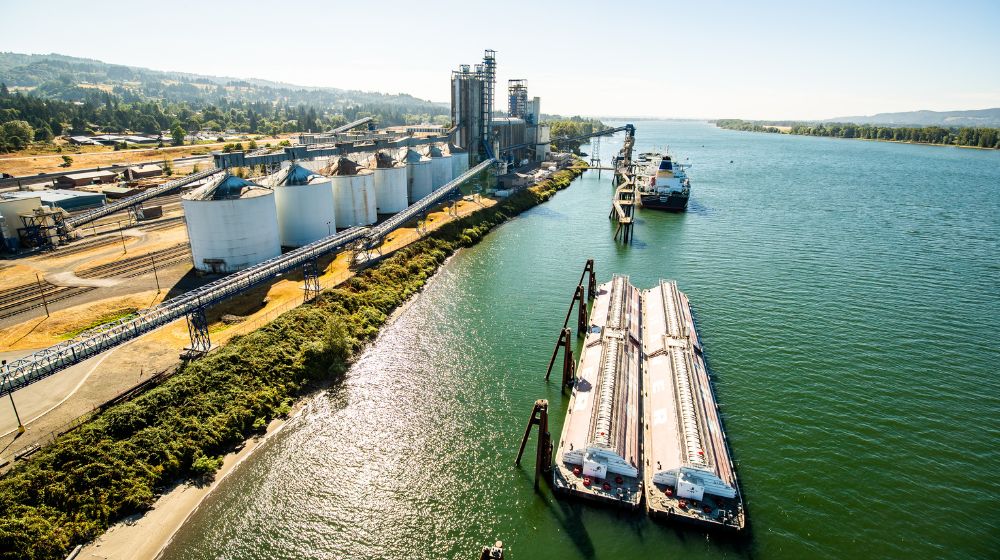
As global demand for U.S. grains shifts, Southeast Asia has emerged as one of the most important growth regions for U.S. agriculture. “Southeast Asia will remain one of the strongest growth regions for global grain and oilseed demand,” says Patrick Guan, director of commodity marketing, who is based in the CHS Singapore office. “Population growth, rising incomes and continued expansion in poultry, swine and aquaculture is expected to keep driving imports of feed grains, soybeans and meals, and food-use wheat.”
Demand growth is unfolding amid changes in global trade flows. “Commodity trade flows are shifting,” says Bryce Banfield, vice president of international sales with CHS. “Many countries around the world are increasing their production, improving logistics and transportation capabilities and providing quality grain to meet market demands.” As a result, Banfield notes, “The U.S. has lost export market share of corn and soy in some markets.”
Southeast Asia, however, is a region where domestic consumption is increasing, and production levels are not keeping pace with demand growth. Tropical growing conditions limit production of many temperate crops, making the region reliant on global grain suppliers.
Several forces will shape Southeast Asia’s import demand over the next five years. Protein consumption will remain the primary driver, while relative competitiveness between origins will continue to shift based on freight rates, currency movements, production outcomes and trade policy. Approvals for new biotech products and food safety regulations will also influence which exporting countries are chosen. Unpredictable weather and potential logistics disruptions will make the market even more uncertain.
Evolving customer expectations
“Most customers in Southeast Asia are shifting toward deliberate multi-origin strategies,” Guan says. “The U.S. remains a core anchor for quality and reliability, but it’s no longer about a U.S.-only solution. Customers want flexibility and partners who can manage that complexity.” That shift is forcing exporters to adapt their commercial models. “CHS has to change to meet customer demands,” Banfield says. “If we rely only on the U.S. to source and sell grain, we lose relevance.” Today’s buyers expect suppliers to be present in the market every day.
“Relative origin competitiveness is constantly changing,” Guan says. “Price, freight, currency, trade policy and weather all influence which origin wins business at any given time.”
Buyer expectations are evolving alongside these dynamics. Grain buyers increasingly prioritize reliable execution, on-time vessels, consistent quality and clean documentation, in addition to competitive pricing and uninterrupted supply. “Grain buyers want suppliers that can provide high-quality, competitively priced commodities without supply interruptions,” Banfield says, noting that CHS continues to strengthen its end-to-end supply chain through targeted infrastructure investments.
For U.S. farmers and farmer-owned cooperatives like CHS, this environment underscores the importance of scale, coordination and global reach. U.S. supply remains foundational, but it is increasingly complemented by origination from other areas of the world. “Our customers are looking for commodities 365 days a year,” he adds. A multi-origin approach allows CHS to remain competitive while continuing to connect U.S. crops to global demand.
“Our strength is being a multi-origin partner with a strong U.S. base,” Guan says. “We still rely on the U.S. for consistency and quality, but we complement that with Australia through CHS Broadbent, the Black Sea via our Romanian terminal and South America through CHS assets in Argentina and Brazil. That flexibility helps us serve customers and protect demand for U.S. farmers.”
Adapting to Southeast Asia’s changing expectations
In another market shift, larger integrators across Southeast Asia are moving beyond spot purchases toward structured, multi-season programs. “Customers today want more than the cheapest cargo on the day,” Guan says. “They want insight, risk management tools and long-term partnerships that help them navigate volatility.”
That shift is shaping how CHS engages in the region. The cooperative is increasingly structuring multi-origin, multi-season supply programs that combine U.S., Brazilian, Australian and Black Sea volumes under a single commercial framework. Advisory services and flexible pricing structures help customers manage risk across futures, freight and physical supply.
“We’re working to be the partner sitting next to the customer,” Guan says. “That means helping design the right origin mix, contract structure and timing, not just executing a transaction.”
CHS is also deepening its regional presence, including opening a new office in Ho Chi Minh City to strengthen local engagement. “Being closer to the market matters,” Guan says. “We want to be seen as a long-term strategic partner in Southeast Asia’s growth, supported by a truly global origination base.”
As competition intensifies, exports remain critical to U.S. farmers’ success. “U.S. farmers are the most productive in the world,” says Chris Pothen, senior vice president, international, with CHS. “Exports are vital to their success, and the cooperative system is set up with the right assets to facilitate that. It really takes a co-op.”
As Southeast Asia’s role in global food demand continues to expand, the opportunity for U.S. agriculture is clear, but capturing it requires adaptability. By combining the strength of U.S. production with global origination, infrastructure investment and a cooperative mindset, CHS is helping ensure that growth in Southeast Asia translates into long-term opportunity for America’s farmers.


